5G Revolution and the Road to 6G: Connecting Everything
Explore the revolution brought by 5G and look ahead to 6G, the next frontier in connectivity. Discover how these networks enable Terahertz speeds, microsecond latency, and power use cases like holographic communication and the massive Internet of Everything (IoE).

Five years ago, 5G was a buzzword promising faster phone speeds. Today, it is the fundamental infrastructure powering the Fourth Industrial Revolution. 5G (Fifth Generation) is far more than just “faster 4G”—it is a paradigm shift in how devices, machines, and people communicate, unlocking applications that were once confined to science fiction.
Let’s dive into the core capabilities of 5G and explore the exciting trajectory toward Beyond 5G (B5G) and 6G.
What Makes 5G a Game Changer?
To understand the revolution, we must look beyond raw speed. 5G delivers three primary performance improvements over 4G LTE, forming a crucial “triad of capabilities”:
1. Enhanced Mobile Broadband (eMBB)
This is the feature most people recognize. 5G offers peak download speeds up to 20 Gbps (gigabits per second) and average speeds in the hundreds of Mbps. This massive bandwidth enables experiences like:
- Ultra-High-Definition Streaming: Seamless 4K and 8K video streaming on mobile devices.
- Immersive Experiences: High-quality, untethered Virtual Reality (VR) and Augmented Reality (AR) applications for gaming, education, and collaboration.
2. Ultra-Reliable Low-Latency Communication (URLLC)
Latency is the delay between sending information and receiving a response. 4G latency typically ranges from 50–100 milliseconds (ms). 5G targets latencies as low as 1 ms (millisecond). This near-instantaneous response time is critical for mission-critical applications:
- Autonomous Vehicles: Instantaneous communication between vehicles (V2V) and infrastructure (V2I) for real-time decision-making, ensuring safety.
- Remote Surgery: Allowing specialist surgeons to operate robotic arms remotely with zero perceived lag.
- Industrial Automation: Real-time control of factory robots and machinery (Industry 4.0).
3. Massive Machine-Type Communications (mMTC)
This refers to the ability to connect a massive number of devices in a small area. 5G can reliably support up to 1 million devices per square kilometer (100 times more than 4G). This is the key enabler for the true Internet of Things (IoT):
- Smart Cities: Connecting millions of sensors for traffic management, utility monitoring, smart lighting, and environmental sensing.
- Smart Agriculture: Deploying thousands of sensors across fields to monitor soil health, irrigation needs, and crop growth in real-time.
The Technical Backbone of 5G
How does 5G achieve these feats? It primarily relies on three key spectrum bands:
| Spectrum Band | Frequency Range | Characteristics | Typical Use Case |
|---|---|---|---|
| Low-Band (Sub-6 GHz) | Below 1 GHz | Wide area coverage, penetrates walls well. Slower speeds. | Blanket coverage, rural areas. |
| Mid-Band (Sub-6 GHz) | 1 GHz to 6 GHz | The “Goldilocks” spectrum—balances speed and coverage. | Urban and suburban connectivity, most common 5G use. |
| High-Band (mmWave) | 24 GHz and up | Extremely fast speeds, but very short range and easily blocked. | Dense urban centers, stadiums, and specific factory floors. |
Additionally, 5G utilizes Massive MIMO (Multiple-Input Multiple-Output) antenna arrays and Beamforming, which intelligently direct signals directly to the user’s device, enhancing efficiency and reliability. Another crucial feature is Network Slicing, which allows operators to create independent, virtualized networks optimized for specific tasks (e.g., one slice for ultra-low latency surgery, another for high-bandwidth streaming).
Beyond 5G: The Vision for 6G
As 5G deployment matures, research is already moving into the Sixth Generation (6G), expected to be commercially available around 2030. While 5G focused on making connectivity better, 6G is focusing on making connectivity intelligent, omnipresent, and integrated with the physical world.
The key goals of 6G include:
- Peta-bit Speeds: Aiming for speeds up to 1 Terabit per second (Tbps), far exceeding 5G’s Gbps maximum.
- Zero Latency: Latencies potentially in the microsecond range, making the experience virtually instantaneous.
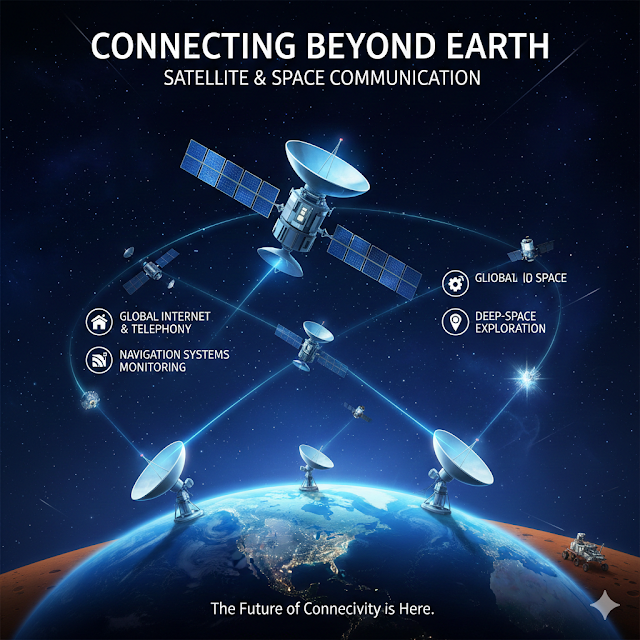
- Ubiquitous Coverage: Integrating terrestrial, aerial (drones, High-Altitude Platform Stations or HAPS), and Non-Terrestrial Networks (NTN) like low-earth orbit (LEO) satellites to provide seamless coverage everywhere on Earth.
- Integrated Sensing and Communication (ISAC): This is a defining feature. 6G will not only transmit data but also sense the environment. The network infrastructure itself will act as a giant radar system, measuring distances, movement, and context.
- Hyper-Realistic Communication: Enabling technologies like holographic calls and truly integrated Digital Twins, where a virtual model of a physical object or system is updated in real-time via the network.
In essence, 6G will transition from merely connecting devices to creating a globally connected, intelligent computational fabric that merges the physical and digital realities.
5G has laid the robust foundation necessary for the digital future. It is a testament to constant innovation, and the journey to 6G promises a world where connectivity is not just fast, but truly invisible and transformative.