The Sky’s the Limit: Navigating the Ever-Evolving World of Cloud Computing
Dive into the ever-evolving world of Cloud Computing. Explore the latest trends—from Serverless and Hybrid Cloud to Edge Computing and AI integration—and learn how to navigate this dynamic landscape for business innovation and growth.

In the modern digital age, where data is the new oil and connectivity is king, one technology stands head and shoulders above the rest in enabling innovation and agility: Cloud Computing. Far from being just a buzzword, the cloud has fundamentally reshaped how businesses operate, from tiny startups to global enterprises. It’s the invisible infrastructure powering our favorite apps, streaming services, and AI breakthroughs.
Imagine a world where instead of buying expensive servers, hiring IT staff, and constantly maintaining hardware, you could simply “plug in” to a vast, on-demand pool of computing resources over the internet. That’s the essence of cloud computing – a paradigm shift from owning IT infrastructure to accessing it as a service.
What Exactly is Cloud Computing?
At its core, cloud computing is the delivery of computing services—including servers, storage, databases, networking, software, analytics, and intelligence—over the Internet (“the cloud”). Instead of directly owning and maintaining your own computing infrastructure, you can access these services from a cloud provider, paying only for what you use.
Here’s a breakdown of the fundamental characteristics that define cloud computing:
-
On-Demand Self-Service: Users can provision computing capabilities, such as server time and network storage, as needed automatically without requiring human interaction with each service provider.
-
Broad Network Access: Capabilities are available over the network and accessed through standard mechanisms that promote use by heterogeneous thin or thick client platforms (e.g., mobile phones, laptops, and PDAs).
-
Resource Pooling: The provider’s computing resources are pooled to serve multiple consumers using a multi-tenant model, with different physical and virtual resources dynamically assigned and reassigned according to consumer demand.1
-
Rapid Elasticity: Capabilities can be elastically provisioned and released, in some cases automatically, to scale rapidly ou2tward and inward commensurate with demand. To the consumer, the capabilities available for provisioning often appear to be unlimited and can3 be appropriated in any quantity at any time.
-
Measured Service: Cloud systems automatically control and optimize resource usage by leveraging a metering capability at some level of abstraction appropriate to the type of service (e.g., storage, processing, bandwidth, and active user accounts). Resource usage can be monitored, controlled, and reported, providing transparency for both the provider and consumer.
The Pillars of Cloud Services: IaaS, PaaS, SaaS
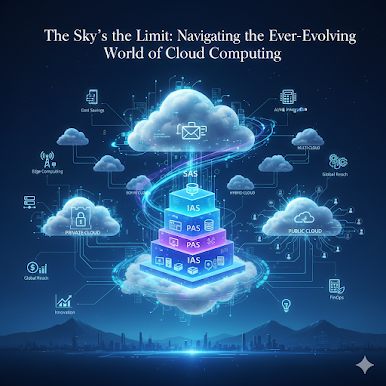
Cloud computing isn’t a one-size-fits-all solution. It offers different service models to cater to varied needs, often visualized as a stack:
-
Infrastructure as a Service (IaaS): This is the most basic layer, providing virtualized computing resources over the internet. Think of it as renting the fundamental building blocks: virtual machines, storage, networks, and operating systems. You manage the applications, data, runtime, and middleware.
-
Examples: Amazon EC2, Microsoft Azure Virtual Machines, Google Compute Engine.
-
-
Platform as a Service (PaaS): PaaS offers a complete development and deployment environment in the cloud. It includes IaaS elements plus an operating system, programming language execution environment, database, and web server. Developers can focus on writing code without worrying about the underlying infrastructure.
-
Examples: AWS Elastic Beanstalk, Heroku, Google App Engine, Azure App Service.
-
-
Software as a Service (SaaS): This is the most common and consumer-facing model. SaaS provides ready-to-use software applications over the internet, managed entirely by the vendor. Users simply access the software via a web browser or mobile app.
-
Examples: Gmail, Salesforce, Dropbox, Microsoft 365, Slack.
-
Deployment Models: Where Your Cloud Lives
Beyond the service models, cloud computing also has different deployment models dictating where the infrastructure is located and how it’s managed:
-
Public Cloud: Services are delivered over the public internet and are available to anyone. A third-party provider owns and operates the hardware, software, and other supporting infrastructure.
-
Examples: AWS, Microsoft Azure, Google Cloud Platform.
-
-
Private Cloud: Dedicated cloud infrastructure exclusively for a single organization. It can be physically located on the company’s premises or hosted by a third-party service provider. It offers more control and security.
-
Hybrid Cloud: A combination of public and private clouds, allowing data and applications to move between them. This offers flexibility, allowing organizations to run critical workloads on a private cloud while leveraging the scalability of the public cloud for less sensitive applications or burst capacity.
-
Multi-Cloud: The use of multiple public cloud services from different providers. This strategy aims to avoid vendor lock-in, improve resilience, and leverage specific features from different providers.
The Benefits: Why Businesses are Moving to the Cloud
The shift to cloud computing isn’t just a trend; it’s driven by tangible business benefits:
-
Cost Savings: Reduce capital expenditure on hardware and infrastructure, convert it to operational expenditure, and pay only for resources consumed.
-
Scalability & Elasticity: Easily scale resources up or down to meet fluctuating demand, ensuring optimal performance without over-provisioning.
-
Global Reach & Performance: Deploy applications closer to users worldwide, reducing latency and improving user experience.
-
Increased Agility & Innovation: Developers can quickly provision resources and deploy applications, accelerating time to market for new products and services.
-
Reliability & Disaster Recovery: Cloud providers often offer robust backup, recovery, and redundancy features, ensuring business continuity.
-
Security: Major cloud providers invest heavily in security infrastructure, often surpassing what individual companies can afford, though shared responsibility for security remains.